Plastic Bag Progress Stalls Among Retailers with 272 Million Still Sold Last Year
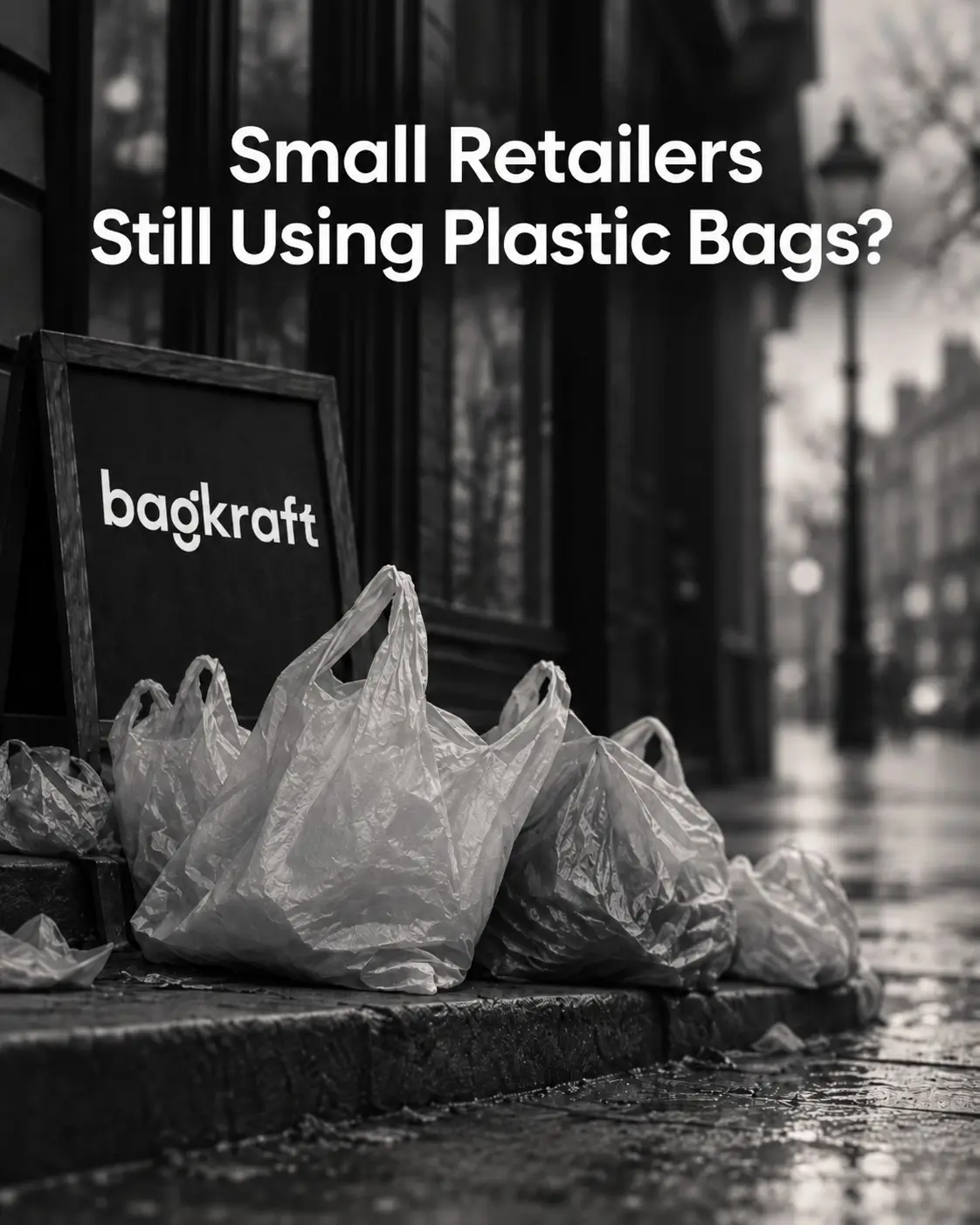
Plastic Bag Progress Stalls Among Retailers – with 272 Million Still Sold Last Year
England has made huge progress in reducing single-use plastic carrier bags over the past decade. But new analysis by BagKraft reveals that progress among retailers outside the biggest supermarket groups has slowed dramatically – with 272 million bags still reported as sold last year.
BagKraft analysed Department for Environment, Food & Rural Affairs (Defra) carrier bag data covering 2016/17 to 2025/26.
In 2025/26:
- 272 million single-use plastic carrier bags were sold by non-supermarket reporting retailers
- 126 million were sold by seven main supermarkets
- 399 million were sold across all reporting retailers
That means retailers outside the seven main groups now account for around 68% – more than two-thirds – of England’s reported single-use plastic carrier bag sales.
More strikingly, while the main retailers cut their total by around 23% last year, other retailers reduced theirs by less than 1%.
Progress Appears to be Stalling
Other reporting retailers sold approximately 273 million single-use plastic carrier bags in 2024/25. In 2025/26, that figure was still approximately 272 million.
Compare that with Defra’s seven main retailers – Asda, Marks & Spencer, Morrisons, Sainsbury’s, Tesco, The Co-operative Group and Waitrose.
Their combined total fell from approximately 164 million to 126 million in the same year, a reduction of around 23%.
The trend is similar over the long-term. Other reporting retailers have reduced annual sales from approximately 789 million in 2016/17 to 272 million today – a fall of around 65.5%.
The seven main retailers have gone from 1.327 billion to 126 million – a reduction of approximately 90.5%.
As a result, the wider retail sector’s share of reported single-use plastic carrier bag sales has increased from around 37% to 68%.
Ten Years of Plastic Bag Decline
Across all reporting retailers, single-use plastic carrier bag sales have fallen approximately 81%, from 2.116 billion in 2016/17 to 399 million in 2025/26.
|
Year |
Main Retailers |
Other Retailers |
Total |
|
2016/17 |
1.327bn |
789m |
2.116bn |
|
2017/18 |
1.010bn |
744m |
1.754bn |
|
2018/19 |
549m |
578m |
1.127bn |
|
2019/20 |
226m |
402m |
628m |
|
2020/21* |
197m |
292m |
489m |
|
2021/22 |
246m |
251m |
497m |
|
2022/23 |
133m |
301m |
434m |
|
2023/24 |
133m |
274m |
407m |
|
2024/25 |
164m |
273m |
437m |
|
2025/26 |
126m |
272m |
399m |
*Defra advises caution when comparing 2020/21 because of the impact of Covid-19.
Four of the seven main retailers – Marks & Spencer, Sainsbury’s, Tesco and Waitrose – reported zero qualifying single-use plastic carrier bag sales in 2025/26.
That doesn't necessarily mean they use no plastic carrier bags. Defra’s figures specifically cover bags meeting the regulatory definition of a single-use plastic carrier bag and exclude some reusable bags and bags for life.
Nevertheless, the comparison demonstrates how dramatically retail packaging can change.
What Can Other Retailers Do Differently?
The wider retail sector is much more fragmented than the supermarket market. A fashion boutique, takeaway, garden centre and gift shop all have different packaging requirements.
There is no single replacement for plastic that suits every retailer.
For many businesses, paper carrier bags offer a practical alternative. They are particularly suited to fashion, beauty, gifting, hospitality and general retail, and can range from straightforward kraft carriers to premium printed bags. Other businesses may find a durable reusable bag more appropriate.
The important thing is not to assume one material is automatically the most sustainable. Retailers should consider the amount of material used, durability, recyclability, expected reuse, the product being carried and what happens to the bag at the end of its life.
There is also another question worth considering: would the customer actually want to keep it?
Could the Bag Become Part of the Customer Experience?
A carrier bag is unusual packaging because it leaves the store in the customer’s hand. It can be seen on the high street, on public transport and in homes.
US retailer Trader Joe’s has demonstrated how far that idea can go. Its inexpensive mini canvas totes became sought-after products in their own right, generating queues, social media attention and a resale market. It has been such a success that Lidl has now emulated the bag with its own version.
That's an exceptional example, but the principle is relevant to other retailers. A distinctive printed craft bag can carry an independent retailer’s identity around its local high street. A premium bag can become part of a fashion or gifting experience. A well-designed reusable tote might remain in use long after the original purchase.
Instead of simply asking “What can we replace our plastic bags with?”, retailers could ask: “What would our customers actually value carrying?”
The Next Phase of the Plastic Bag Transition
The first decade of England’s carrier bag transition has delivered enormous change. Reported single-use plastic carrier bag sales have fallen by approximately 81% since 2016/17. Now the challenge has shifted.
The next opportunity is across the wider retail sector. For some businesses, the answer could be an appropriately specified paper carrier. For others, it could be a genuinely reusable bag.
Either way, the conversation can move beyond simply replacing plastic towards choosing packaging that uses the right amount of material, suits the product and adds something to the customer experience.
The best replacement for a disposable plastic bag might not simply be a different disposable bag. It could be one customers actually want to carry.
About The Data
This analysis uses Department for Environment, Food & Rural Affairs data on the Single-use Plastic Carrier Bags Charge in England from 2016/17 to 2025/26.
Figures have been rounded where appropriate. The data relates specifically to qualifying single-use plastic carrier bags and should not be interpreted as measuring all plastic carrier bags supplied by retailers.
Source: Department for Environment, Food & Rural Affairs, Single-use plastic carrier bags charge: data for England, 2025 to 2026 and historical carrier bag datasets.